Doctoral research · DBA · May 2026
Board Capital Activation and Crisis Recovery.
Subtitle: Director Evidence on Crisis Knowledge.
Timothy Harvey Gentry · Fox School of Business, Temple University · Doctor of Business Administration · May 2026.
“Activation captures the shift from stored resources to observed board involvement and resource use.”
The governance question, the empirical work, and the contribution.
Crisis episodes raise governance stakes and shorten decision windows, resulting in limited empirical access to board conduct once crisis conditions prevail. Prior work centres on risk-management systems and crisis communication, with board involvement in resource mobilisation and strategic reconfiguration under shock remaining comparatively under-specified.
Drawing on board capital theory and Bourdieu’s capital conversion logic, the study defines board capital activation as the process through which directors’ latent human and social capital becomes coordinated board action during crisis episodes, and specifies prior crisis knowledge as a conditioning factor shaping activation.
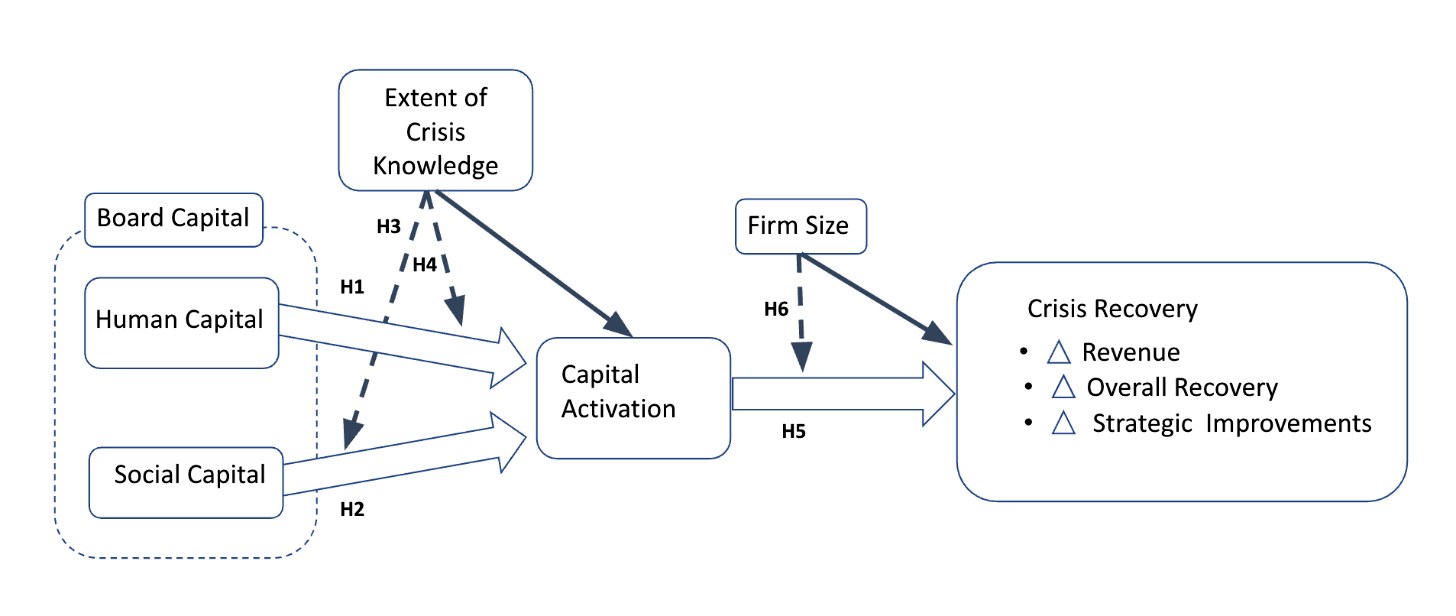
Data derive from semi-structured director key-informant reports from corporate directors, each describing one focal crisis episode spanning multiple crisis types. Recovery was assessed six months post-crisis and was estimated via PLS-SEM with bootstrapped inference. The model tests whether board human and social capital predict capital activation, and whether capital activation predicts recovery, with crisis knowledge conditioning the social-capital-to-activation link.
Results indicate positive links from board human capital and board social capital to capital activation, a strong activation-to-recovery relationship, and an interaction in which crisis knowledge strengthens social-capital activation, but not human-capital activation. These findings show that board influence affects capital activation during the governance of a crisis and extend board capital theory with a reusable measurement approach suited to crisis settings where direct observation of board deliberation is infeasible.
How the constructs relate.
What the data showed.
03.1
Board human capital activates capital.
Director experience, expertise, and tenure show a positive link to capital activation during crisis episodes.
03.2
Board social capital activates capital.
The relational capital held by directors also predicts activation. That includes external ties, peer networks, and ecosystem access.
03.3
Activation predicts recovery.
Capital activation has a strong relationship with firm recovery six months post-crisis.
03.4
Crisis knowledge strengthens the social-capital path.
Prior crisis knowledge meaningfully amplifies how social capital converts into activation. It does not significantly amplify the human-capital path.
03.5
Firm size has its own effect.
Firm size does not moderate the activation-to-recovery association, but it is directly associated with recovery.
What it means for practice.
04.1
For boards
Composition matters, but activation matters more. Boards add asymmetric value when there is a method for routing the right director to the right operating question during stress. Simply having expertise on the roster is not enough.
04.2
For CEOs and chairs
Working agreements with explicit cadences for crisis-relevant director consultation outperform agreements that rely on the regular board calendar. The interaction effect on social capital suggests that director prior experience is most usefully engaged through relational channels.
04.3
For investors and lead directors
Investments in director routing infrastructure return most heavily during the crisis itself. Firms that build such infrastructure only at the point of stress find that it does not operate in time.
04.4
For governance research
The study contributes a reusable measurement approach for activation in settings where direct observation of board deliberation is infeasible. It addresses a long-standing access constraint in crisis-period governance research.
Where the work was done.
Degree
Doctor of Business Administration (DBA)
Conferred
May 2026 · Temple University Graduate Board
Institution
Temple University · Fox School of Business
Method
Quantitative field study · structured key-informant interviews (n=81 corporate directors) · PLS-SEM with bootstrapped inference
Published via
ProQuest Dissertations & Theses Global · view on ProQuest →
Committee
- Detmar William Straub · Advisory Chair, Management Information Systems
- Sezgin Ayabakan · Management Information Systems
- Munir Mandviwalla · University of South Florida
- Crystal Reeck · External Reader, Marketing
How to cite this work.
Gentry, T. H. (2026). Board capital activation and crisis recovery: Director evidence on crisis knowledge (Publication No. 3344335015) [Doctoral dissertation, Temple University]. ProQuest Dissertations & Theses Global.
APA · 7th edition
Note
The dissertation is available in full via ProQuest Dissertations & Theses Global (Publication No. 3344335015). Boards, CEOs, and academic colleagues without ProQuest access may request a reading copy via the contact page.